Oversight Is the Product
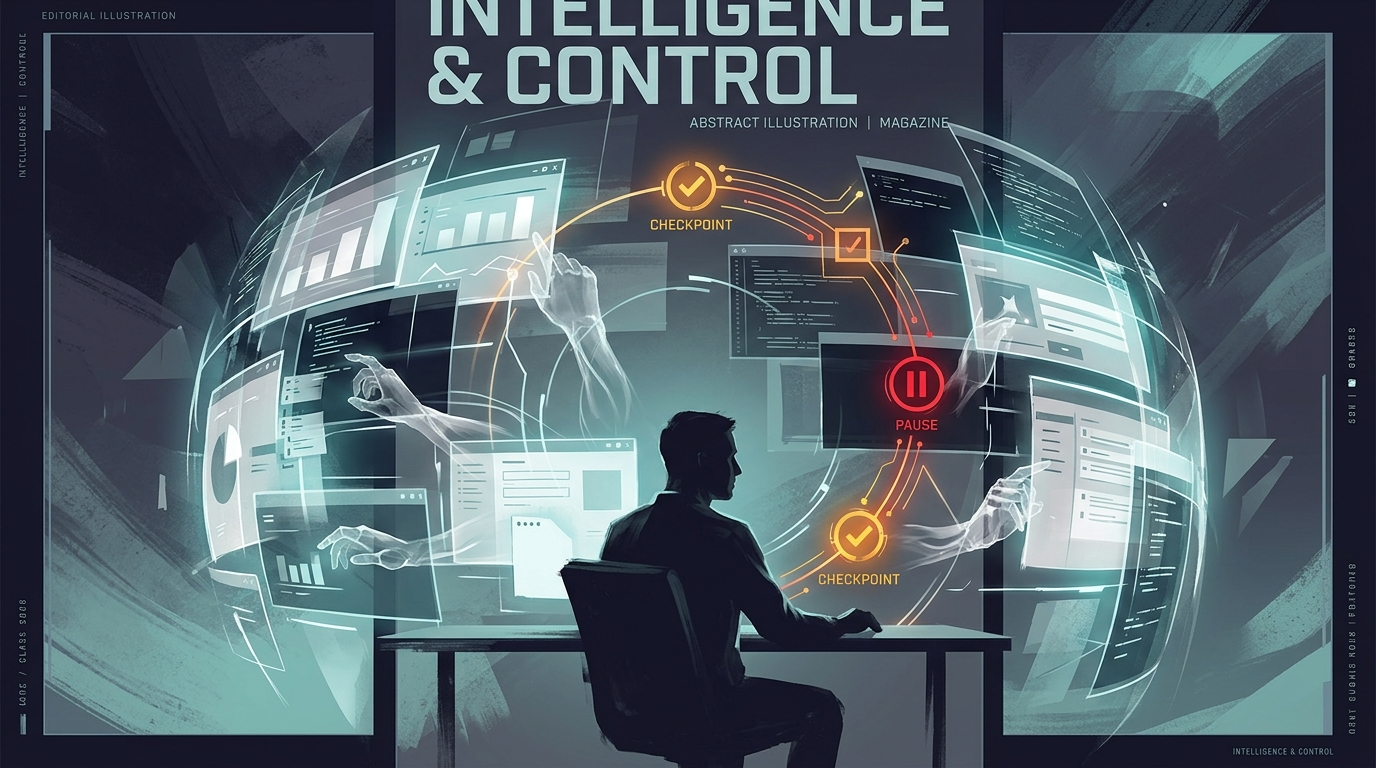
The unit of design is the loop
Computer-use agents do not merely answer questions; they click through websites, fill forms, send messages, and trigger transactions. Because they act through brittle graphical interfaces and changing webpages, small interpretation errors can become real-world side effects. In that setting, safety and usefulness are no longer properties of the model alone. They emerge from a closed loop between person, interface, and model. A recent HCI preprint on computer-use agents, posted as arXiv:2604.04918, foregrounds exactly this point: delegation works when users can inspect intent, shape scope, and recover from error, not when autonomy is treated as a one-time handoff.
That argument extends a longer HCI lineage. Lee and See’s research on trust in automation emphasized calibrated reliance, not blind confidence. Amershi and colleagues’ human-AI interaction guidelines likewise stress that systems should make clear what they are doing and support efficient correction. In cybernetic terms, oversight is how a human-AI system acquires requisite variety: the model will never anticipate every edge case, but the loop can still absorb surprises if the interface gives humans timely ways to intervene.
Delegation is graded, not binary
The common framing—either full autonomy or manual control—breaks down quickly in computer use. Consider a travel-booking agent. It can search routes, compare refund rules, and fill booking forms, yet still stop at the payment screen for confirmation. Or consider an enterprise support agent that drafts replies and issues routine refunds automatically, but pauses when the amount exceeds a threshold, a policy looks ambiguous, or regulated data is involved. In both cases, the real architecture of trust lies in the checkpoints around the model, not the model in isolation.
Approval gates localize irreversible risk. Interruptibility lets a person stop execution before a small mistake compounds across applications. Transparency means showing current goal, next action, affected apps, and uncertainty boundaries—not simply dumping internal reasoning. Escalation paths tell the agent what to do when the world stops matching the plan: ask, defer, or hand off. These are not UX extras. They are the mechanism by which oversight becomes operational.
For agentic systems, trust is built less by claims of autonomy than by evidence that autonomy can be constrained, inspected, and revoked.
From dispositions to assurance
This is why evaluation itself is shifting. Google HCI’s April 2026 essay, Evaluating alignment of behavioral dispositions in LLMs, makes a useful distinction between a model’s abstract dispositions and its behavior in context. A model may look aligned in a text-only probe yet behave dangerously once given a browser, a payments page, and a user pressing for speed. The inverse is also true: a merely competent model can become dependable inside a well-designed oversight loop.
The practical implication is that alignment can no longer be assessed only at the level of the base model. Teams need to test live systems: whether users can notice drift, veto risky actions, recover from bad states, and understand when the agent is out of bounds. The most consequential artifact is not just the benchmark score or the model card; it is the control surface that structures approval, interruption, and escalation in use.
As computer-use agents move from demos into payroll, procurement, customer service, and personal administration, the decisive product question may no longer be whose model is most capable. It may be whose oversight loop is most legible, governable, and resilient when the task stops being tidy. When that happens, what exactly will count as innovation: smarter agents, or better ways for people to stay meaningfully in control?